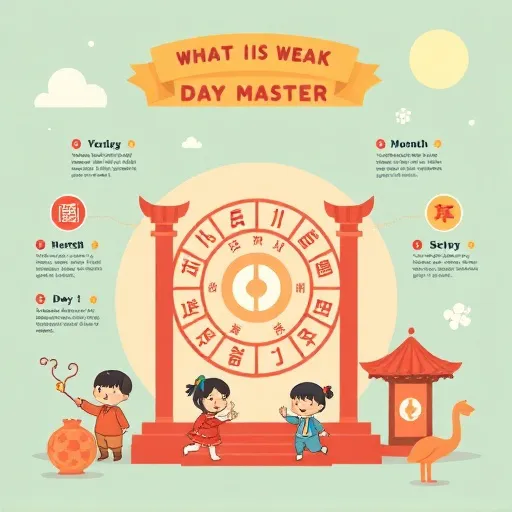
Bazi four pillars ov
The Basics: What Is a Day Master in Bazi?
Before we dive into the question of what is a weak day master in bazi, let's zoom way out for a second. Bazi, also known as the Four Pillars of Destiny, is a system of Chinese astrology that maps out your birth date and time into four pillars—year, month, day, and hour. Each pillar contains a Heavenly Stem and an Earthly Branch, and together they form your birth chart. Pretty cool, right?
The Day Master is the Heavenly Stem of your Day Pillar. In simple terms, it's you—the core representation of your identity, your personality, and how you interact with the world. Think of it as the protagonist in the story of your chart. Everything else in the chart—the other seven characters—either supports, drains, controls, or clashes with this central figure. So when we ask what is a weak day master in bazi, we're really asking how much backup that protagonist is getting from the rest of the story.
Your Day Master is one of the Ten Heavenly Stems, each associated with an element (Wood, Fire, Earth, Metal, or Water) and a polarity (Yin or Yang). For example, you might be a Yang Wood Day Master (think of a tall, sturdy tree) or a Yin Fire Day Master (think of a candle flame). Each has its own flavor and vibe.
Understanding the Weak Day Master Meaning in Bazi and Four Pillars
Here's where people often get confused. In Bazi, the term weak Day Master doesn't mean you're emotionally weak, physically frail, or destined for a life of struggle. It's a technical term that describes the balance of elemental support in your birth chart. When folks search for what is a weak day master in bazi, they're usually surprised to learn it's about elemental math, not personal weakness.
A weak Day Master simply means that the element representing you is not strongly supported by the rest of the chart. There aren't many other elements that produce or reinforce your element, and there may be plenty of elements that drain, control, or weaken it. In other words, your Day Master is "outnumbered" in the elemental tug-of-war happening inside your birth chart. That's the heart of what is a weak day master in bazi—an underdog element that needs backup.
Conversely, a strong Day Master has lots of support—resources that feed it and peers that share its element. Neither strong nor weak is inherently "good" or "bad." They just require different strategies for balancing the elements and finding harmony. Understanding what is a weak day master in bazi is really about understanding balance, not deficiency.
A Quick Campfire Analogy for the Weak Day Master in Bazi
Imagine your Day Master is a small campfire. If you're surrounded by wet wood, strong wind, and heavy rain (elements that drain or control Fire), that fire is going to have a hard time staying lit. That's a classic weak Day Master scenario—and honestly, it's the easiest way to visualize what is a weak day master in bazi. But if you've got dry logs, calm air, and a sheltered spot (elements that support Fire), the flame thrives. The fire itself isn't "bad"—it just needs the right environment to shine.
How Do You Know If Your Day Master Is Weak in Bazi Charts?
Determining the strength of your Day Master is one of the first things a Bazi practitioner does when reading a birth chart. It involves several factors, and this is exactly where the answer to what is a weak day master in bazi gets practical:
- Season of birth: The month pillar is the most influential. If your Day Master element is in its peak season (e.g., Fire born in summer), it's naturally stronger. If it's in its weakest season (e.g., Fire born in winter), it's likely weaker.
- Support from other stems and branches: Look for elements that produce your Day Master (the Resource element) or share its element (the Peer element). More of these means more support.
- Draining and controlling elements: Elements that your Day Master produces (Output), controls (Wealth), or that control your Day Master (Officer) all pull energy away from it.
- Rooting: Does your Day Master have a "root" in the Earthly Branches? A hidden stem of the same element in the branches gives it stability.
- Combinations and clashes: Sometimes branches combine to create new elements or clash to disrupt existing ones, which can shift the balance significantly.
A skilled practitioner weighs all of these factors together. It's not a simple counting game—context matters enormously. This is why chart interpretation is an art as much as a science. And it's why figuring out what is a weak day master in bazi takes more than a quick glance at one element.
Personality Traits and Ten Gods of a Weak Day Master
People with a weak Day Master often share certain traits. Now, these are tendencies, not absolute rules—your whole birth chart matters. But generally speaking, a weak Day Master tends to be:
- Adaptable and flexible: Because the chart is more influenced by other elements, these individuals often go with the flow and adjust well to changing circumstances.
- Sensitive and perceptive: They tend to pick up on subtle energies and emotions around them.
- Collaborative: They often thrive in team settings and benefit from partnerships, since they draw strength from others.
- Thoughtful and reflective: They may spend more time processing before acting.
- Prone to overthinking: On the flip side, a weak Day Master can sometimes feel overwhelmed by external pressures or struggle with indecision.
The Ten Gods (also called Ten Deities) play a big role here too. They're the relationships between your Day Master and the other elements in your chart. In a weak Day Master chart, the Ten Gods that represent support—Direct Resource and Indirect Resource (Resource element), as well as Friend and Rob Wealth (Peer element)—tend to be especially important. These "helping" gods indicate where support comes from in your life. Meanwhile, the Ten Gods that drain or control the Day Master—Eating God, Hurting Officer, Direct Wealth, Indirect Wealth, Direct Officer, and Seven Killings—can be challenging for a weak chart unless they're well-balanced by supportive elements. But again, context is everything. Sometimes a weak Day Master with a powerful Seven Killings can be incredibly dynamic and successful in certain fields.
Recognizing these patterns isn't about labeling yourself—it's about understanding your natural tendencies so you can play to your strengths and compensate where needed.
Why a Weak Day Master Isn't a Bad Thing in Chinese Metaphysics
Let's bust a major myth right now: a weak Day Master is not a disadvantage. In fact, many highly successful people have weak Day Masters. The key is understanding what your chart needs and how to align with it—which is the real insight behind what is a weak day master in bazi.
In Bazi theory, a weak Day Master generally benefits from supportive elements—the Resource and Peer elements. These are considered favorable elements (or Yong Shen) for that person. When those elements show up in a year, a month, or a life direction, things tend to flow more smoothly. When they're absent, challenges may arise, but that's true for everyone.
Think of it this way: a strong Day Master usually needs to be "drained" or "controlled" to find balance, while a weak Day Master needs to be "supported" or "nourished." Both types are working toward the same goal—balance in the chart.
Favorable Elements and Career Paths for a Weak Day Master
Here's a quick rundown of what typically helps support a weak Day Master:
- Resource element: This is the element that produces your Day Master. For example, if you're a Wood Day Master, Water is your Resource element. It represents support, knowledge, mentorship, and nurturing.
- Peer element: This is the same element as your Day Master. For a Wood Day Master, that's more Wood. It represents allies, friends, and community support.
- Seasonal timing: Years, months, or even days governed by these supportive elements can feel more energizing and aligned.
Conversely, elements that drain or control the Day Master (Output, Wealth, and Officer elements) are often considered less favorable for a weak chart. But here's the nuance—those elements aren't "bad" forever. In some charts, a weak Day Master can actually handle them well under the right conditions. This is why personalized chart analysis matters so much when unpacking what is a weak day master in bazi.
Career choices that align with favorable elements tend to feel more natural and rewarding for a weak Day Master. Fields related to your Resource element (education, research, counseling, supportive roles) or your Peer element (team-based work, partnerships, community-focused roles) are often a good fit. That said, real-world practicality always comes first—use this as a guiding lens, not a rigid rulebook. Many Bazi enthusiasts also use annual luck pillars and luck cycles to time big moves. When favorable elements are active in your current cycle, it can be a good time to launch a business, change careers, or make major life changes.
Common Misconceptions About What Is a Weak Day Master in Bazi
There's a lot of misinformation floating around, so let's clear up a few things:
- "Weak means unlucky." Not true. A weak Day Master is just a chart characteristic. Luck depends on the interplay of all elements, including luck pillars and annual cycles.
- "You should avoid your unfavorable elements at all costs." In reality, a balanced life includes all elements. Complete avoidance isn't practical or necessary. The goal is awareness and strategic adjustment.
- "Everyone with a weak Day Master has the same personality." Absolutely not. The other pillars, the Ten Gods, and the overall chart configuration create enormous variety. Your Day Master strength is just one piece of the puzzle.
- "Weak Day Masters can't be leaders." Plenty of leaders with weak Day Masters succeed by building strong teams and delegating effectively. Their collaborative nature can be a huge asset.
If you're just starting out with Bazi analysis, here are a few tips to keep in mind. Use a reliable Bazi calculator to get your Four Pillars accurately first—the birth time matters a lot, especially for the hour pillar. Don't rely on just one factor when assessing what is a weak day master in bazi; strength is determined by multiple variables—season, rooting, support, draining, and combinations. Study the Five Elements cycle, because understanding how Wood, Fire, Earth, Metal, and Water interact is foundational to Chinese metaphysics. Seek expert guidance for a full reading, and stay curious and patient—Bazi is a deep system that even experts are constantly refining.