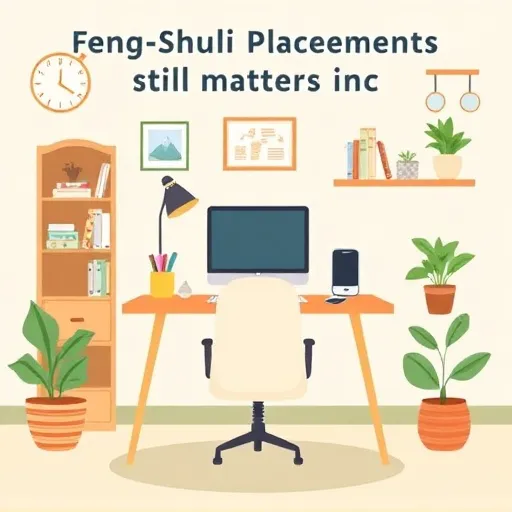
Workplace wellness i
Why Desk Placement Still Matters in 2026
The whole conversation around workplace wellness has done a complete 180 over the past few years. Remote work and hybrid schedules are now just... normal for a massive chunk of the workforce, and folks are treating their home office setups with the same obsessiveness they used to save for fancy corporate floors. Recent industry insights show the home office furniture and wellness market keeps exploding, with ergonomic gear and "intentional workspace" products leading the charge. And honestly? That's exactly why feng shui office desk placement rules have made a serious comeback.
Feng shui — the ancient Chinese practice of arranging your environment to optimize the flow of energy, or qi — has found a whole new generation of adherents. And here's the thing: a lot of these feng shui office desk placement rules overlap beautifully with modern environmental psychology. Good lighting, a clear line of sight to the door, a solid wall behind you — these aren't just spiritual prescriptions. They're practical, research-backed ways to reduce anxiety and boost focus. That's the bridge between tradition and contemporary workspace design, and it's why feng shui office desk placement rules deserve a spot in your 2026 setup.
The Commanding Position and Energy Flow: The Golden Rule of Desk Placement in Feng Shui
If you take away only one thing from this entire article, make it this: the commanding position. In feng shui, the commanding position is the spot in a room where you can see the door clearly without being directly in line with it. You're not facing the entrance head-on, and you're not turning your back to it either. You're at a comfortable diagonal, with a solid wall behind you. This single principle sits at the heart of all feng shui office desk placement rules.
Why does this matter so much? Because in feng shui philosophy — and in stress psychology, frankly — having your back exposed to an entry point creates a subtle sense of vulnerability. Your nervous system stays slightly on edge. You can't fully relax into deep work. Placing your desk so you can see who's coming while feeling supported from behind is the single most important feng shui office desk placement rule you'll ever learn.
How to Find Your Commanding Position Using Bagua and Energy Paths
- Identify the room's main entry door.
- Position your desk diagonally across from the door, not directly facing it.
- Ensure a solid wall (not a window or open shelving) is behind your chair.
- Avoid sitting directly in the "energy path" between the door and the farthest window.
If your room layout makes a true commanding position impossible — tiny apartments, weird angles, shared spaces — don't panic. You can approximate it. A small mirror placed so you can see the door reflection works as a workaround. Some practitioners also suggest a plant or a tall object behind you to simulate the support of a wall. These little hacks keep the feng shui office desk placement rules workable even in less-than-ideal spaces.
Common Desk Placement Mistakes: Blank Walls, Back to Door, and Sloped Ceilings
Feng shui is as much about what not to do as what to do. Here are the big no-nos when it comes to positioning your workspace.
1. Facing a Blank Wall Too Closely. Sitting with your nose practically against a wall creates a sense of stagnation. Energy can't flow, and neither can your ideas. If space is tight, at least leave a comfortable distance and hang something inspiring — a piece of art, a vision board, a plant — to give your gaze somewhere to land.
2. Back to the Door. This is the classic feng shui faux pas. Having your back to the entrance is believed to invite instability and leave you feeling "sneaked up on." In modern terms, it's a low-grade stress trigger that chips away at concentration — one of the most universally agreed-upon feng shui office desk placement rules to respect.
3. Directly Under a Window (or Facing One Without Shade). Windows are lovely for natural light, but sitting directly beneath one can feel exposed, and staring straight into bright glare is a recipe for eye strain and distraction. Position your desk perpendicular to the window rather than facing it head-on, and use sheer curtains or blinds to modulate the light.
4. Under a Sloped Ceiling or Exposed Beam. Traditional feng shui views heavy beams overhead as pressure points — symbolic of stress and burden. If you can't move your desk, a canopy or a lighter paint treatment on the beam can help soften the effect.
5. In the Direct Line of a Doorway. Sitting in the direct path between a door and a window — sometimes called the "money-losing" alignment — is believed to let energy (and, symbolically, prosperity) rush right past you. Shift your desk to the side of that invisible line. These are the feng shui office desk placement rules people break most often without even realizing it.
Desk Orientation and the Five Elements: Directional Associations for Career Growth
Beyond the physical position, feng shui also considers the direction your desk faces and the elemental associations tied to each compass direction. You don't need to be a compass-carrying purist, but it's a fun and surprisingly useful layer to experiment with. Think of it as advanced feng shui office desk placement rules for people who want to go deeper.
- North: Water element — associated with career growth and deep focus. Great for analytical work.
- East: Wood element — linked to creativity, new beginnings, and health. Ideal for writers and designers.
- South: Fire element — tied to recognition and passion. Suits roles that involve visibility and leadership.
- West: Metal element — associated with completion and communication. Good for project managers and finishers.
- Northeast and Southwest: Earth element — grounding, stability, and relationships.
That said, the commanding position always trumps direction. If you have to choose between facing a "perfect" compass direction and sitting in a supportive, secure spot, choose the supportive spot every time. Feng shui is about harmony, not rigid rule-following — and that's one of the most liberating feng shui office desk placement rules of all.
Decluttering and Cable Management: The Silent Rule Nobody Talks About Enough
Here's the thing about feng shui office desk placement rules — they're meaningless if your desk surface looks like a paper avalanche. Clutter is the enemy of qi. It blocks energy flow and, in very practical terms, blocks your ability to think clearly. A 2026-era remote worker juggling multiple digital tools and physical notebooks knows this struggle intimately.
Keep your desk surface as clear as reasonably possible. Store supplies in drawers or closed containers. Cables? Tame them. A tangled nest of cords under your desk is a modern feng shui nightmare — it represents chaos and stagnant energy. Cable management isn't just aesthetic; it's energetic hygiene, and it belongs right up there with the classic feng shui office desk placement rules.
- Clear all non-essential items from the desktop daily.
- Use closed storage for office supplies.
- Route and bundle cables neatly.
- Remove dead plants and broken items immediately.
- Keep only items that serve a purpose or bring genuine joy.
Plants, Lighting, and Personal Items: Supportive Elements for a Calming Workspace
Once your desk is positioned well, you can layer in elements that enhance the energy of the space. This is where feng shui gets fun — and where the feng shui office desk placement rules turn into a creative playground.
Plants. Living plants are the quintessential feng shui enhancer. They represent growth, vitality, and the wood element. A small potted plant on your desk — think a pothos, a snake plant, or a ZZ plant for low-light offices — softens sharp corners and adds life. Avoid cactus or spiky plants right on the desk surface; their sharp energy is traditionally associated with tension.
Lighting. Good lighting is non-negotiable. Natural light is ideal, but layered lighting — an overhead source plus a focused task lamp — gives you control and warmth. Avoid harsh fluorescent glare directly overhead, which can feel draining.
Personal Touches. Objects that carry positive meaning — a photo of loved ones, a small piece of art, a meaningful stone or crystal — anchor good energy and make the space feel like yours. Just don't let these items multiply into clutter. A few intentional pieces beat a crowded shelf every time. These finishing touches are what make feng shui office desk placement rules feel personal rather than prescriptive.
Small Spaces and Open-Plan Offices: Practical Feng Shui Adjustments for Awkward Layouts
Not everyone has a dedicated room with a perfect commanding position. Here's how to adapt the feng shui office desk placement rules when your space is less than ideal.
- Small room: Use a mirror to create the illusion of a commanding view of the door. Keep the palette light and airy.
- Shared space: Define your zone with a rug, a screen, or a shelf. Clear boundaries help contain and focus energy.
- No window: Compensate with a full-spectrum desk lamp and a plant or image of nature.
- Desk facing a wall: Hang artwork or a pinboard at eye level to avoid the "staring at a blank wall" stagnation.
- Open-plan office: Position your monitor so you have peripheral awareness of approach, and use noise-canceling headphones to create an energetic boundary.
Feng Shui and Technology: Managing EMF and Digital Clutter in 2026
Here's something the ancients didn't account for: electromagnetic fields. In 2026, our desks are packed with monitors, laptops, routers, and charging stations. Some contemporary feng shui practitioners suggest minimizing the number of electronics directly around your body and keeping routers and power strips at a reasonable distance. Whether or not you buy into the EMF concerns, there's an undeniable psychological benefit to a desk that isn't a chaotic tangle of glowing screens and buzzing devices — a modern update to timeless feng shui office desk placement rules.
Consider creating a small "tech-free" zone on your desk — even just a corner — where your phone doesn't live. It's a modern twist on an old principle: create space for calm amid the noise.
Putting Feng Shui Office Desk Placement Rules Into Practice: A Step-by-Step Setup
Ready to rearrange? Here's a simple sequence to follow.
- Assess the room. Identify the door, windows, and any awkward architectural features.
- Find the commanding position. Aim for a diagonal view of the door with a solid wall behind you.
- Check for hazards. Avoid beams overhead, direct doorway alignments, and close-facing walls.
- Declutter and organize. Clear the surface, manage cables, and establish a home for every item.
- Layer in elements. Add a plant, adjust lighting, and place one or two meaningful personal items.
- Test and tweak. Sit in the space for a few days. Notice how it feels. Adjust as needed — feng shui is iterative, not one-and-done, and these feng shui office desk placement rules work best when you treat them as a starting point.
So here's the bottom line: feng shui office desk placement rules aren't about superstition — they're about intentionality. They're a framework for arranging your workspace so that it supports focus, reduces stress, and feels genuinely good to sit in. In 2026, when so many of us are navigating hybrid schedules and carving out productivity in every corner of our lives, that intentionality is more valuable than ever.
Start with the commanding position. Clear the clutter. Add a plant. See how it feels. You might be surprised at how much a small shift in desk placement can shift your entire workday — and that's the real magic of feng shui office desk placement rules. Now go move that desk.